

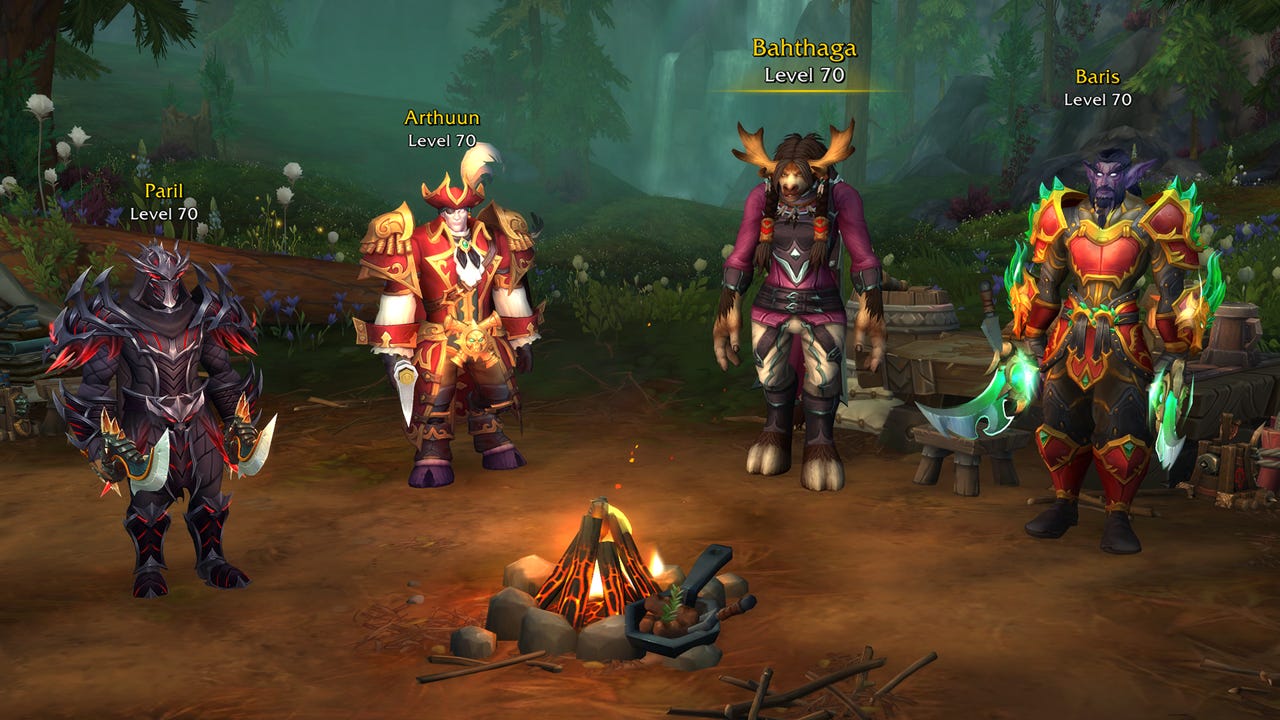
World of Warcraft was my first real interaction with a skinner box.
A skinner box:
…allows researchers to study animal behaviour [sic] and response to conditioning. They do this by teaching an animal to perform certain actions (like pressing a lever) in response to specific stimuli. When the correct action is performed the animal receives positive reinforcement in the form of food or other reward…
…which is a bit dry.
If you’ve never played World of Warcraft (WoW), it was one of the first big mainstream massively-multiplayer-online-role-playing-games (MMORPG or MMO for short). Releasing in 2004, I resisted playing for a year or so, until my brother texted me that his guild needed a warrior and I happened to be unemployed at the time. I fired up the game, created my toon and started to power-level.
What followed was a hazy couple of months. Worries about finding a job quickly fell away, replaced with worries about hitting level 60. I’d take meals in front of the game, often letting them go cold once I found a group to join to do an instance. When I wasn’t playing, I was thinking about playing. Playing WoW became the highlight of my day - winning a loot roll on the purple you’ve been instancing all week for felt better than anything going on in my real life.
WoW and its’ contemporaries introduced gamers and wanna-be game developers to gamification and, through it, the skinner box. By making the game “juicy” and provide lively and pleasing visual and audio feedback when you achieve a goal, you tap into the chemical reward signal of the brain, and the dopamine hit is immediate and makes you feel great. Wow! (pun intended.) That was fun, and the best part is it was easy - way easier than doing a creative hobby, working, doing chores or really trying to achieve any goal in real life.
If you’re not careful, and back then I wasn’t, pulling this dopamine handle can become more important than getting a job, moving out and getting your life back on track. Every time you fire up the game, you know you’re going to feel great and like you’re making headway in achieving goals. Why bother trying things in real life and failing when you know you can succeed in the game?
This is a skinner box. The reward is the “juice” and the dopamine hit, and the task is to keep playing the game. Keep getting more powerful equipment, in order to take on more difficult instances, in order to get more powerful equipment…
You know what else feels just as fun as WoW? Vibecoding with LLM agents like Claude Code and Codex.
I’ve been coding since I was 15 or 16. I fell in love with the feeling of solving a tricky problem and bending the code to your will to create things from nothing. At the start it was harder - I was less sure of how to do what I wanted and less sure of how to find out how to do it. The wins were rare and hard won, and the pleasure of satisfaction of solving a problem I’d been working on for weeks was great.
As I gained more experience, I learned that for me, this was how programming was. No matter how frustrated and stuck I’d feel while trying to solve my current problem, perseverance, reading the docs, and judicious online searching combined with trial-and-error would usually get me unstuck and allow me to complete my goal and giving me satisfaction. To me, this is the appeal of programming. This feedback loop of problem, struggle, breakthrough, solution is fun and it’s why I choose to do this for a career.
On the surface, these feelings between WoW and programming are similar. Both are satisfying and make me feel good. But the skinner box feels hollow. I know the “struggle” to grind a quest or find a loot drop isn’t really a struggle. It’s not actually challenging, and I’m not actually growing in any way beyond perhaps my hand-eye co-ordination. The achievement feels hollow and there’s a gnawing voice in the back of my mind telling me I’m wasting my time.
I do not get this feeling when programming. Or I didn’t, before Claude Code.
When I use Claude, I can feel it tickling the same parts of my brain that WoW tickled. Staring at the empty Claude prompt with a world of possibilities ahead of me, it’s exciting to type out your prompt and see the agent churn away at the work. A handful of minutes later, it chirpily declares that it’s complete, your automated stock trading robot is ready to make you millions on your lunch break.
Like WoW, as I use Claude to build ray tracers, game engines and coding agents, I can hear that same gnawing voice telling me that I’m not growing, I’m not learning and the struggle isn’t real. I’m not in the trenches with the code, reasoning through the problem as I try to model concepts and logical flows. I’m not enhancing my understanding of the problem and I’m not really understanding the code the agent is writing.
Sure, I can read the code and follow what it’s doing; but I don’t have insight as to why I chose a certain solution over another. I could ask the agent, but the agent is unreliable - the reason it gives me is a probabilistic completion of all the reasons this code was written this way in its training corpus. The agent itself has no idea why it did it other than “this is the way I was told to do it.” There’s a level of understanding that someone needs to have about the code that is now missing.
It’s not just me: research shows that people who use ChatGPT to write essays struggle to accurately quote their own work.
This is a skinner box. The reward is the completed code, and the task is to keep spending tokens. Write a prompt and feel productive. Find something wrong, write a prompt. To add a feature, write a prompt. Sometimes you’ll get the thing you want, sometimes you’ll get something close enough, and sometimes it all goes wrong. When it goes wrong, it’s frustrating and often you can feel stuck. You don’t understand everything the agent wrote, and it clearly doesn’t either otherwise you wouldn’t be stuck. Ah, but when it goes right, there’s that dopamine hit and it feels fun again.
But it’s just as hollow as WoW. I’m feeling good but I’m not growing.
Worse, I’m starting to prefer to prompt and spin the bug wheel than to dig in and figure out what’s going on myself. I’m choosing the game over real life. Beyond AI psychosis, this skinner box is another hidden danger of using agentic coding.
Before you think it, the solution isn’t to not use these tools. They’re too powerful and legitimately good at certain kinds of tasks - you definitely need to learn how to work with them to maintain a development career in 2026.
I think the way forward is understanding and accepting that you’re just not going to understand vibecoded source as well as source you wrote by hand. Use that to evaluate risk, and if there’s a part of your problem that’s important or particularly complex, perhaps prefer to code that by hand to gain that contextual knowledge rather than pulling the handle and spinning the wheel.