

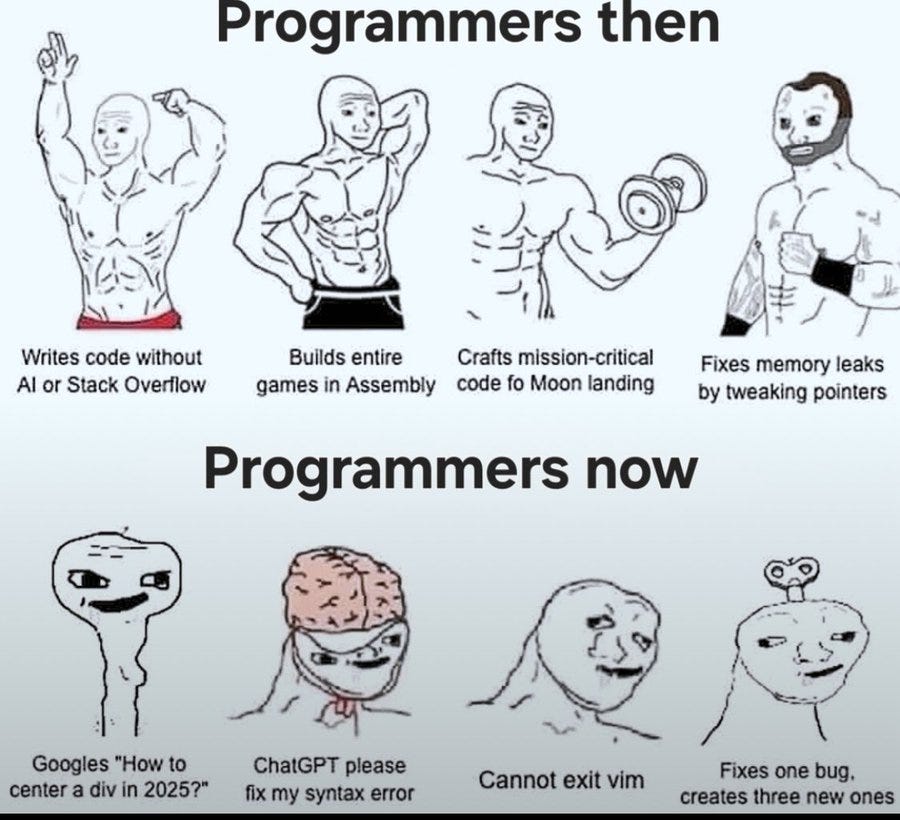
Dear random person posting online asking for help finding a programming job,
Hi.
I’m not sure if you remember, but I reached out sometime ago to try to help you with your ongoing job search. Communication kind of broke down between us - our last exchange ended with me sending you a link to a job from my personal network with a promise to send more, and well - I ghosted you.
In my defense, you didn’t reply to the job link I sent you asking if it’s in the direction you’re looking. I’d have appreciated at least acknowledgement of the gesture, but I understand how stressful finding a job is and hopefully things picked up for you and you got sidetracked by actually getting a job.
I reached out because I thought I could help you find a job. I’ve done this a few times with friends, whether it’s helping them up-skill in SQL, working their resume/CV to be more appealing to hiring managers/interviewers or drilling some real-time mock interviews. Most of the time I’ve been successful too! One of my friends managed to switch from a sales role into a data role, and another friend finally landed a contract job followed by a permanent role after I started to help.
You sent me your resume - I took a look, and honestly there’s nothing wrong with it. The way you’re looking for roles is how I would do it, and the cover letters you’re sending seem OK, if a little rambling and overly personal - but hey, that’s a personal representation decision and I’m not going to tell you to change what you’re doing. On paper, you’re doing everything right.
Yet, I’m not actually that surprised you’re having a hard time finding work.
The market is truly fucked right now, worse than even a few years ago. Big tech is still cutting deep, this time claiming AI can do the jobs of the people they’re laying off. Meanwhile interest rates remain high, borrowing is expensive and many businesses are bracing for lower revenue in the coming quarters. Even if we buy the AI claims at face value, there’s a lot of other factors that are also coming into play when discussing software engineer layoffs.
The market is being flooded with programmers of varying levels of experience. I myself was on the market earlier in 2025 at 20+ years of experience. I’ve read social media posts online from engineers with 5-8 years of experience struggling to find new roles. From my understanding, new graduates entering the market are finding it almost impossible to get roles.
During our conversation, between intentionally or unintentionally ignoring certain questions and kinda-but-not-quite answering the questions you did answer, I get the impression that you’re not amazing at your job, and I’m guessing other hiring managers are also getting that impression.
Now, I know you’re going to bristle at that. Nobody likes hearing that they’re not great at their jobs even though it’s the only way to get better at your job. The thing is, I definitely picked up a lack of focus, a lack of attention to detail and a lack of passion for the work. It very much felt like you just wanted a job in programming as opposed to wanting a job programming. Do you see the difference?
That’s a problem these days. As the tech industry liquidates workers and going all-in on AI, you’re going to be competing with people who actually are great at their jobs. If you got into software development as a career purely because it was lucrative back in the 2010s, you’re in for a nasty shock. Did you know that before Meta, AWS, and the “big tech” company, this career didn’t pay very well? In fact, a lot of us got into it because we liked doing it and were just grateful that somebody was willing to pay us anything.
These programmers do it for fun. They’ll do it while somebody is paying them $300k per year, and they’ll do it while somebody is paying them $120k per year if they have to. They’re really good at their jobs too. These are the kind of people who log off their work laptops at the end of a day’s coding, grab some dinner and then log onto their personal laptops, and keep going. They build things to learn how to build things. They build things just for fun.
So, when a hiring manager talks to you, oh person who barely seems adequate, and they’re talking to someone who’s more experienced, more knowledgable and more passionate than you are - who do you think the hiring manager is going to go with, given y’all are both applying for the same job with the same salary band?
I’m sorry, I know this is hard to hear - you’re not going to make it.
This career of ours is going through a fundamental, landscape changing transition. Regardless of your personal thoughts on AI and LLM technology - big tech has embraced it, and there is now enough money invested in this nascent technology that it will happen. It won’t be smooth, and it won’t be easy. Things are going to get worse before they get better - by things, I mean interacting with any kind of customer service, advertising, cold-calling. Anything that can be automated with AI is being automated with AI, even if it doesn’t work. They’ll make it work later when their income is threatened.
The cuts will continue, and if the promise of AI and agentic coding comes true as all these companies are hoping it does, there will be fewer roles available and the competition for a role will return to levels we haven’t seen in about 15-20 years. I remember getting my first programming job back in 2004 was exceedingly difficult - there was a small pool of employers, competition was tough and opportunities were rare. My first full-time job wasn’t even really programming - I spend 75% of my time cleaning fire damaged cash registers and uploading price sheets via a COM cable - it took me another 9 months to find an actual programming job.
This is now an employer’s market, and the programming industry is undergoing a great filtering - those who are in it just for the cash aren’t going to make it. Hiring managers and interview panels have the luxury of expecting more from candidates than that they log on for 40 hrs a week, push a handful of PRs and attend required meetings.
Lately my socials have been exposing a lot of career growth material. None of it is revolutionary and most of it is solid advice - “do the job you want, not the job you have”, various overviews of expectations of junior/senior/staff/principal engineers in various businesses, highlights of soft skills that are important to success.
Some of the resistance I’m seeing from my peers in the industry is a little alarming. There’s push back on going above and beyond, of proving your value before asking for money. There seems to be this cynical posture to the employer/employee relationship that is largely transactional - and not really appropriate in an employers market.
I understand. For the last 10-ish years, you’ve held most of the leverage. Tech employers were desperate to take advantage of cheap borrowing and show growth to boost the value of their equity. Keeping you away from the competition was worth almost as much as getting your value. You didn’t have to excel to advance, because the hiring machine was always churning and if your current employer wouldn’t promote you, some new employer would be willing to hire you at the next level up.
No more.
Your “show up and do the job” isn’t going to cut it anymore. We’re back in the days of the passionate enthusiast. Tech companies are going to want you to do more for less and eventually you’ll be asking yourself “Is this shit worth it? Maybe I can re-skill into better career?” I’ve seen this happen personally, twice - usually when a programmer jumps to being a product manager.
If you do find yourself asking this question, you should seriously consider it. Because now you’re going to be competing for roles against people who will always answer “yes, this shit is worth it” - for the love of the game, not for the money.